
Academic Degree Programs at Colorado Chinese Medicine University
Colorado Chinese Medicine University (CCMU) offers a comprehensive academic pathway in acupuncture and Chinese medicine, including master’s-level, entry-level professional doctoral, and post-professional doctoral programs.
Each degree is designed to serve a distinct stage of professional development, from entry-level clinical education to advanced doctoral-level practice and leadership.

Overview of Degree Levels
CCMU’s academic programs are structured across three primary degree levels:
-
Master’s Degrees – Entry-level professional education preparing students for licensure
-
Professional Doctoral Degrees – Doctoral entry-level education integrating advanced clinical training
-
Post-Professional Doctoral Degrees – Advanced doctoral education for licensed practitioners
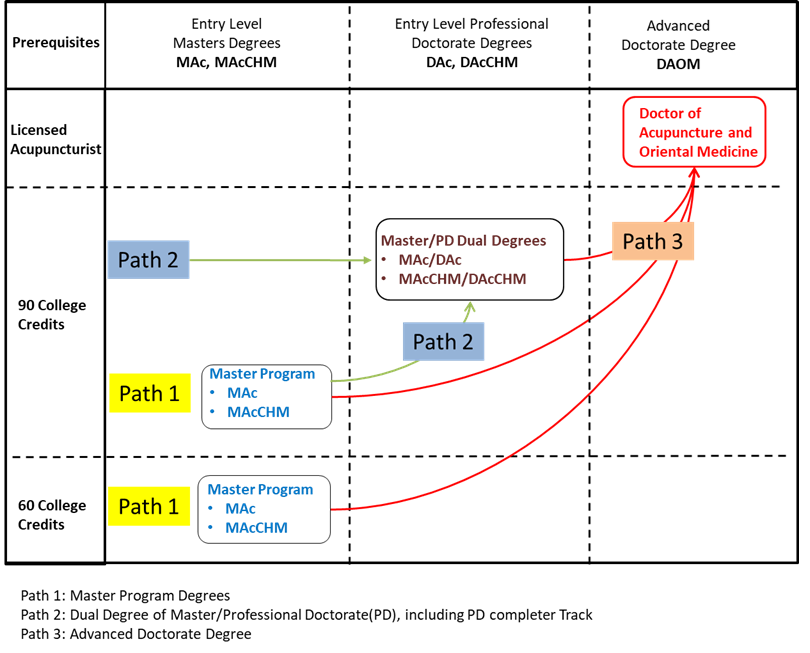
Degree Comparison Table
| Degree | Full Name | Degree Level | Intended Audience | Clinical Scope | Program Focus | Prerequisite |
|---|---|---|---|---|---|---|
| MAc | Master of Acupuncture | Master’s | Entry-level students | Acupuncture | Foundational clinical practice & licensure preparation | 60 college credits (Associate’s) |
| MAcCHM | Master of Acupuncture with Chinese Herbal Medicine | Master’s | Entry-level students | Acupuncture + Herbal Medicine | Integrated TCM clinical practice | 60 college credits (Associate’s) |
| DAc | Doctor of Acupuncture | professional doctorate | Entry-level doctoral students | Acupuncture | Doctoral-level clinical training | 90 college credits (Bachelor’s/3 years) |
| DAcCHM | Doctor of Acupuncture with Chinese Herbal Medicine | professional doctorate | Entry-level doctoral students | Acupuncture + Herbal Medicine | Integrated doctoral clinical practice | 90 college credits (Bachelor’s/3 years) |
| DAOM | Doctor of Acupuncture and Oriental Medicine | Post-professional doctorate | Licensed practitioners | Advanced acupuncture & OM | Advanced clinical mastery & scholarly inquiry | Acupuncture license |
Which Degree Is Right for You?
Why study Chinese herbal medicine?
Chinese herbal medicine is a powerful tool for ongoing regulation of the body outside of acupuncture sessions, as well as a requirement for accreditation in a number of states. However, the program is longer than degrees primarily focused on acupuncture, and requires commitment and dedication to learning.
What program is best for those new to acupuncture and Chinese medicine?
Our Master’s of Acupuncture (MAc) and Master’s of Acupuncture with Chinese Herbal Medicine (MAcCHM) programs are intended for novices, with the goal of preparing graduates for board licensure and professional practice upon completion of program.
What program is best for those seeking a professional doctorate?
Our Doctor of Acupuncture (DAc) and Doctor of Acupuncture with Chinese Herbal Medicine (DAcCHM) programs prepare students for integrative practice with Western medical providers and for developing professional specializations. Our MAc/DAc and MAcCHM/DAcCHM dual-degree programs are designed for new students who wish to begin their professional education at the doctoral level without completing a separate master’s program.
What program is best for licensed practitioners seeking advanced education?
CCMU’s DAOM program provides advanced, post-professional doctoral education emphasizing clinical mastery, classical theory, and research-informed inquiry. The course is specifically designed for licensed practitioners with existing clinical practices, with only one week of on-campus time per trimester.
Key Distinctions Between Degree Types
- Master’s degrees focus on foundational professional training
-
Professional doctorates provide entry-level education at the doctoral standard, preparing students to enter professional practice
-
Post-professional doctorates (DAOM) are designed for licensed practitioners seeking advanced clinical development
Explore Individual Degree Programs
-
Master of Acupuncture with Chinese Herbal Medicine (MAcCHM) →
-
Doctor of Acupuncture with Chinese Herbal Medicine (DAcCHM) →
Admissions and Academic Guidance
Prospective students are encouraged to review individual program pages and admissions requirements.
CCMU’s admissions team is available to provide guidance based on academic background, professional goals, and licensure pathways.
Program Structure and Study Format
How does CCMU structure its academic year?
Each academic year consists of three 15-week trimesters (Spring, Summer, Fall). Trimesters begin in January, May, and late August/early September. Students have a total of 7 weeks off annually.
What options do CCMU students have in terms of enrollment?
CCMU offers full-time, half-time, and part-time enrollment. We also have an accelerated track, which is our fastest path to graduation. Students work with our administration to find a pace of study that works for them.
Continuing Education & Public Programs
- Continuing Education Units (CEU):
- Seminars/workshops for skill enhancement.
- Qualify for NCBAHM™ (formerly known as NCCAOM) CEU credits for licensed acupuncturists.
- Public Classes:
- General workshops are available to the public.
Accreditation and Academic Recognition
- Accredited by the Accreditation Commission for Acupuncture and Herbal Medicine (ACAHM), recognized by the U.S. Department of Education.
- Approved by the Colorado Department of Education.
- Approved by NC-SARA for distance education.
- Approved to provide distance education by the California Bureau for Private Postsecondary Education (BPPE).
- Accredited by Chinese Service Center for Scholarly Exchange (CSCSE).
- A member of World Federation of Chinese Medicine Societies.
- A member of Council of Colleges of Acupuncture and Herbal Medicine.
- Click here for detailed information.